
When using an oscilloscope or data logging system, how often are you considering, and possibly adjusting, your sample rate? Whether you’re a newbie to using scopes and/or loggers, or you have years of experience with these types of devices, that pesky sample rate parameter still needs to be acknowledged and adjusted accordingly.
Without going down the rabbit hole too far, let’s make sure we are all on the same page. Scopes and data loggers that are collecting/displaying data or waveforms have to “sample” the incoming signal repeatedly so that the device can attempt to replicate the signal for analysis. This means taking little pieces of the signal so that it can hopefully be reassembled to display the larger picture, like a jigsaw puzzle if every piece was to be put together in a certain order to complete the picture.

The above figure shows discrete samples in blue, used to approximate the green continuous signal. Photo from这里.
现在,让我们考虑一下所述采样的速度。您怎么知道您是否正在以可接受的速度进行抽样?如果不沿兔子孔太远(再次),就可以确定哪种采样率适合您的数据/信号采集,通常称为Nyquist采样定理。如果您选择进行更深入的探索,就有很多有关该主题的可用文献,但是要点是,nyquist采样定理指出,信号必须以至少两倍的速度进行采样信号。例如:还要记住大多数信号由许多频率组成,假设我正在记录最高频率为6 kHz的信号的数据。因此,我应该以至少2次6 kHz或12 kHz进行采样。
What happens to your data if you are samping below or above this Nyquist rate? Avoiding yet another rabbit hole, sampling under the Nyquist rate introduces what is called aliasing. Essentially, aliasing is a misinterpretation of the sampled signal or data during interpolation. A common example of this is called the Wagon-wheel effect where, for example, a wheel is spinning at a fast enough rate that your eyes cannot process the images fast enough and the wheel spokes start to perceptively spin slower, not at all, or even in the opposite direction. You might encounter this watching movies where the camera’s frame rate is less than twice that of the rate of a spinning wheel that is in the shot. Aliasing is not restricted to visual processing, but can happen with data and other signal processing.

The above figure illustrates sinusoidal aliasing. The pinkish curve was the the original signal, the dots are the sample points, and the dotted curve is the resulting approximation. Notice that the data would show a sinusoid of lower frequency. Photo from这里.
Now, it is recommended to sample at a rate slightly above the Nyquist rate as a buffer to help prevent any aliasing. So just sample at the fastest rate possible, right? Well, that takes larger amounts of memory, power, and does not necessarily provide “better data.” In audio sampling, extreme oversampling can result in what is called ultrasonic intermodulation distortion, which is basically sampled inaudible frequencies that actually degrade the audible frequencies.
The rate you sample at is up to you to decide, depending on the data you are trying to acquire. If you are trying to capture an event that starts and ends within a matter microseconds, then you will need to sample at a very high rate. Using波形生活(open source browser and mobile instrumentation software), theOpenLogger(also open source) can sample up to 400k samples per second (400kS/s) which can accurately log data occuring at frequencies as high as 200kHz. Now, that’s quick on the draw, especially with its 16-bit resolution. Again, though, your choice of sampling rate should be realistic for your data acquisition, and should lean more towards staying above the Nyquist rate.
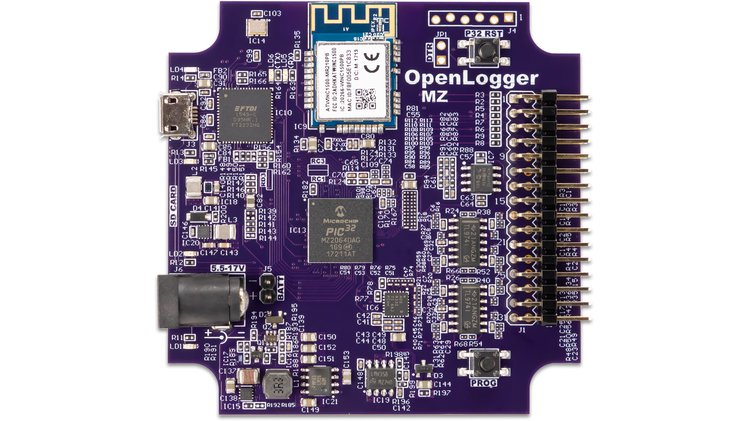
Make sure to head over to theOpenLoggerCrowd Supplypage and to follow its development!


