
Welcome back to the Digilent Blog!
当我们继续探索PMODS时,在检查了一些输出PMOD之后DAC,,,,声音的,,,,andVisualPMODS,我们发现自己处于输出PMOD的最后一组(至少目前)。这五个PMOD都驱动了不同类型的电动机,包括伺服,DC和步进电动机。通过这些PMODS,您可以将项目带到移动中,无论是机器人臂,盒子怪物还是线条跟随机器人。
We’ll start out by checking out the PmodCON3.

This peripheral module is designed to drive up to four servo motors. A servo motor is a type of motor that tends to be restricted in its movement between two different angles. They are also somewhat slow compared to the rest of the motor world. So why use them? Servo motors are used in any application where you need precise movement. By giving the servo motor different pulse lengths ofPWMsignals, a user is able to tell a servo motor to move to an exact angle within its rotation range. With the PmodCON3, it’s easy to control a robot arm without having the large mess of wires that normally comes with controlling multiple motors.
Digilent还提供了两个专门用于驾驶直流电机的PMOD:PMODHB3和PMODHB5。


These two peripheral modules include a 2A H-Bridge circuit that is capable of handling up to 12V. An H-bridge, specifically a full H-bridge, is a type of circuit that allows a voltage to be applied across a device in two different directions. In terms of the PmodHB3 and the PmodHB5, this means that the motor that these Pmods are attached to will be able to run either forwards or backwards. Both of these H-bridge modules control the speed of their DC motors through PWM. DC motors, unlike servo motors, are able to rotate freely much, much faster, but do not have precise control over how far the motor rotates. Both of these motors also have two pins that are able to give feedback on the attached motor’s current speed and rotation.
很像PMODCLS和PMODCLP,这两个PMOD似乎之间没有任何差异。但是,两个不同的名称需要两个模块不同。两者之间的区别在于它们如何合并大厅效应传感器的反馈。
HALL效应传感器作为宽近似,是一种基于与电动机旋转相关的磁场调节其电压输出的设备。PMODHB3假定附件的电动机本质上不包含霍尔效应传感器,因此提供了与电机端子的单独标头,以从分别连接的霍尔效应传感器接收电压信号。另一方面,PMODHB5假定将霍尔效应传感器与直流电动机合并,并在同一标头上提供反馈信号,上面有来自主机板的传入电动机输入。

Finally, Digilent has two Pmods that are able to drive a stepper motor: the PmodDHB1 and the PmodSTEP.


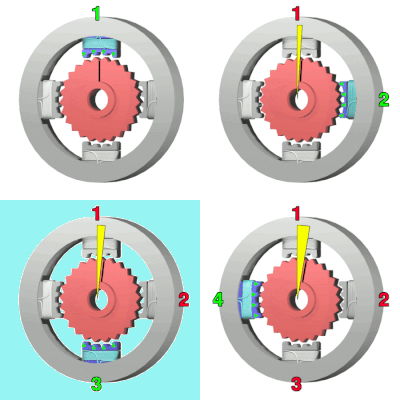
您可能会怀疑,PMODDHB1还包括双H桥(名称的DHB部分),方便地允许该模块以与PMODHB5相同的方式单独驾驶两个DC电机。由于H桥有两个信号,以指示电动机应转弯的方向以及电动机应转弯的速度,因此PMOD能够使用其两个H桥的四个总信号来驱动步进电动机。步进电动机是一种电动机,在电动机轴和驾驶机构之间没有任何物理接触。相反,有一组电磁体在电动机轴周围大大间隔。
当其中一个电磁铁是由一个“打开”voltage signal available from the H-Bridge signal lines, the motor will be induced to rotate so that the teeth are as close as possible to the electromagnet. A second voltage signal can then turn on a second electromagnet immediately next to the first magnet and have the first electromagnet be “turned off” so that the motor shaft is free to rotate futher such that the teeth of the motor are now lined up with the second electromagnet. This cycle is able to continue with the remaining two magnets, creating an overall effect of having the motor spin in one full rotation through 4 “steps”; hence, the stepper motor. By using consistent timing intervals, both the PmodDHB1 and the PmodSTEP will easily drive a stepper motor in a smooth rotation.


如果我选择四相步进电机,我应该如何选择?